


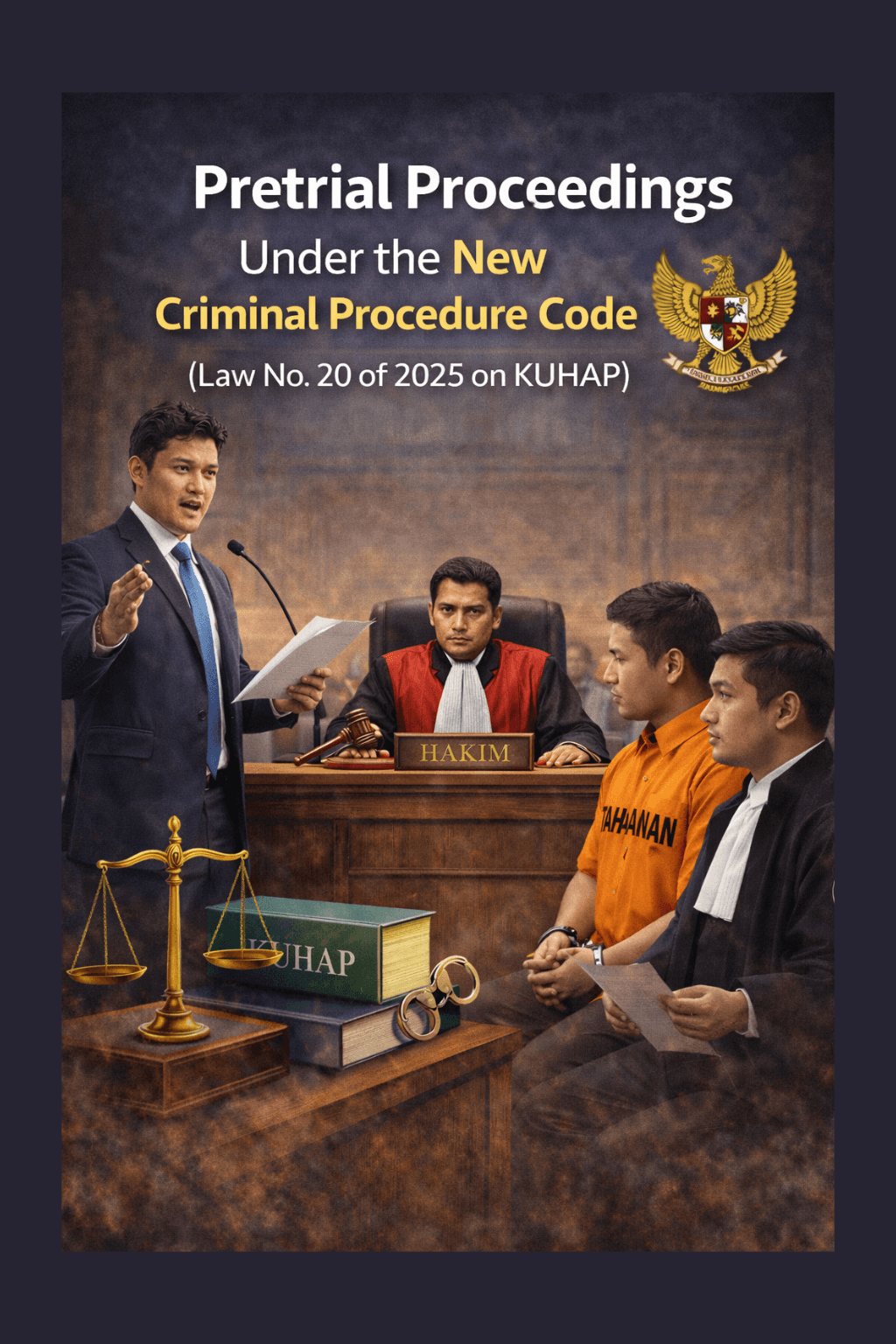
PRETRIAL PROCEEDINGS (PRAPERADILAN) UNDER THE NEW KUHAP
(Law Number 20 of 2025 on the Criminal Procedure Code)
Safeguarding Citizens’ Rights & Constraining the Potential for Arbitrary Exercise of Power by Law Enforcement
Authored by:
Juventhy M. Siahaan, S.H., M.H.
Managing Partner, JBD Law Firm
Introduction
In the criminal justice system, the stages of investigation and prosecution constitute the most vulnerable points for human rights violations. It is at these stages that the State first exercises its coercive powers: arresting, detaining, conducting searches, seizing property, intercepting communications, and designating a person as a suspect.
The problem is that the State’s coercive power inherently carries risks: procedural errors, flawed assessments of evidence, and abuse of authority. In practice, many rights violations do not occur in the courtroom, but long before a case is examined by a judge—namely, from the moment an individual is first subjected to the criminal process.
The old KUHAP (Law No. 8 of 1981) provided Pretrial Proceedings (Praperadilan) as an initial control mechanism over law enforcement actions. However, the narrow and formalistic design of Pretrial Proceedings meant that judicial oversight often failed to function optimally. The designation of suspects, freezing of bank accounts, seizure of strategic assets, and wiretapping frequently escaped early scrutiny, even though their impacts directly affected constitutional rights and the livelihood of individuals or corporations.
This is where the significance of the new KUHAP (Law No. 20 of 2025) lies. The reformulation of Pretrial Proceedings under the new KUHAP is not merely a technical procedural change, but a paradigm shift: from a model of State dominance over citizens toward a rule-of-law model that places law enforcement powers under effective judicial supervision from the earliest stages of the criminal process.
Definition of Pretrial Proceedings
Article 1 point 15 of Law Number 20 of 2025 on the KUHAP defines Pretrial Proceedings (Praperadilan) as the authority of the District Court to examine and decide, in accordance with this Law, the legality of arrest, detention, termination of investigation or prosecution, as well as claims for compensation and/or rehabilitation for a person whose criminal case has been terminated at the investigation or prosecution stage.
Conceptually, Pretrial Proceedings should not be understood merely as a procedural forum for objections. They constitute a constitutional control mechanism over the exercise of the State’s coercive powers. While the State is entitled to enforce the law, such power must not operate without the supervision of an independent and impartial judge. Accordingly, Pretrial Proceedings position the court not only as an institution that adjudicates cases, but also as a supervisor of the exercise of State power over citizens.
Functions of Pretrial Proceedings: Legality, Due Process, and Non-Arbitrariness
The primary function of Pretrial Proceedings is to ensure that every action by law enforcement authorities has a valid legal basis (legality), is carried out through proper procedures (due process of law), and is exercised proportionally and rationally (non-arbitrary power).
Every investigative and prosecutorial measure must be grounded in clear legal authority. No coercive action may arise from habit, assumption, or informal practice. Proper procedure is as important as legitimate objectives, because law enforcement that violates procedure is constitutionally defective. Authority must not be exercised arbitrarily; each action must be supported by objective reasons, proportionality, and rationality that can be tested before a judge.
Through these functions, Pretrial Proceedings operate as an early warning system within the criminal justice process, preventing procedural errors and abuses of power at an early stage, before they develop into irreversible harm to individual rights.
Pretrial Proceedings under the Old KUHAP
Under the old KUHAP (Law No. 8 of 1981), Pretrial Proceedings were designed as a control mechanism over law enforcement actions at the early stage of criminal proceedings. Normatively, they aimed to prevent arbitrary conduct once a person became subject to the criminal process. However, from the outset, the scope of Pretrial Proceedings was narrowly confined and focused more on formal-procedural aspects than on substantive scrutiny of the exercise of State authority.
The objects of Pretrial Proceedings under the old KUHAP were limited to the legality of arrest and detention, the legality of termination of investigation or prosecution, and claims for compensation and rehabilitation. Beyond these, various law enforcement actions with direct and serious impacts on constitutional rights were excluded from early judicial oversight. The designation of suspects, searches, seizures, freezing of bank accounts, and wiretapping—measures capable of paralyzing personal liberty, reputation, and economic rights—were not subject to explicit early judicial control mechanisms.
This limited design produced structural problems in rights protection. Judicial control over the exercise of the State’s coercive power became partial and reactive. Review was often available only after rights had already been violated, or after the case had progressed significantly. In practice, the status of “suspect” frequently functioned as a form of social punishment before adequate judicial scrutiny, while procedurally defective coercive measures were difficult to correct swiftly and effectively.
Conceptually, the design of Pretrial Proceedings under the old KUHAP reflected an outdated criminal justice paradigm that positioned law enforcement agencies as dominant actors at the early stage of proceedings, while courts functioned primarily as ex post reviewers. This model carried serious risks, as law enforcement officials effectively assessed the legality of their own actions before any independent judicial oversight. In such circumstances, the potential for abuse of power was not systematically restrained, but only tested after citizens had already suffered harm.
These conditions prompted the reformulation of Pretrial Proceedings under the new KUHAP. The reform is not merely about expanding the objects of review, but about shifting Pretrial Proceedings from narrow formal control to substantive judicial supervision over the exercise of State authority from the very first step of law enforcement. Through this shift, Pretrial Proceedings are expected to function not as a belated corrective mechanism, but as an effective early protection instrument for the rights and dignity of citizens.
Breakthroughs in Pretrial Proceedings under the New KUHAP
The 2025 KUHAP marks a significant paradigm shift in the design of Pretrial Proceedings in Indonesia. Whereas under the old KUHAP Pretrial Proceedings were limited to formal control over specific law enforcement actions, under the new KUHAP they are reconstructed as instruments of substantive judicial supervision over the exercise of the State’s coercive powers from the earliest stage of criminal proceedings.
This change is reflected in the expansion of the objects of Pretrial Proceedings, which now include the designation of suspects, various forms of coercive measures, and other law enforcement actions that potentially violate citizens’ rights. With this new design, more forms of State power can be tested before a judge at an early stage, before their impacts develop into harm that is difficult to reverse.
The expansion of Pretrial Proceedings authority is not merely technical-procedural. It represents a correction of the structural imbalance between State power and the position of citizens within the criminal process. The State remains empowered to enforce the law firmly, but such power is now framed by more effective and meaningful judicial control. State power is no longer allowed to operate alone at the early stages of criminal proceedings, but is placed under the supervision of an independent judiciary.
Normatively, this breakthrough reflects a more complete adoption of the principle of due process of law. Procedural justice does not stop at the fulfillment of formal stages, but extends to the substance of the exercise of authority itself. What is tested is not only whether procedures have been followed, but whether law enforcement actions are reasonable, rational, and proportionate in restricting citizens’ rights. In other words, Pretrial Proceedings no longer examine only the “how,” but also the “why” and the “appropriateness” of the exercise of power.
With this new design, Pretrial Proceedings are positioned as a constitutional filter over every coercive action of the State. The designation of legal status, temporary deprivation of liberty, restrictions on privacy, and control over property are now placed within the scope of early judicial supervision. This shift encourages a transformation of law enforcement culture from an orientation toward power to an orientation toward legal legitimacy. Law enforcement officials are no longer merely required to act swiftly and firmly, but must also be prepared to justify every exercise of authority before a judicial forum.
Ultimately, the breakthroughs in Pretrial Proceedings under the new KUHAP are not intended to weaken law enforcement agencies. On the contrary, they strengthen the quality of law enforcement itself. Actions that withstand scrutiny in Pretrial Proceedings are legally more legitimate, morally stronger, and more resilient to public scrutiny. Such legitimacy is crucial, because law enforcement perceived as lawful and fair is more readily accepted by society and more effective in the long term.
Nevertheless, strengthening Pretrial Proceedings also demands careful balance, particularly in cases of corruption, money laundering, and organized crime. The protection of constitutional rights must not be distorted into a shield for white-collar criminals adept at exploiting procedural loopholes to obstruct law enforcement. The challenge ahead is not only to ensure that Pretrial Proceedings function as instruments for rights protection, but also to prevent them from being misused as tools of procedural sabotage against law enforcement in cases with systemic impact.
Objects of Pretrial Proceedings (I)
Designation of a Suspect as a Reviewable Legal Act
Under the new KUHAP, the designation of a person as a suspect is expressly positioned as an object of Pretrial Proceedings. This construction is affirmed through the normative definitions of “suspect” and “designation of a suspect” in Article 1 points 28 and 31 of Law Number 20 of 2025 on the KUHAP, which characterize the designation of a suspect as a legal act within the criminal process. With this construction, suspect status is no longer viewed as the absolute discretionary domain of investigators, but as a legal decision carrying serious consequences for constitutional rights and therefore subject to judicial supervision.
Normatively, the legality of designating a suspect may now be tested through Pretrial Proceedings. Such review engages at least two main dimensions: the evidentiary basis and the procedure of designation. From the perspective of evidentiary basis, the designation of a suspect must rest on at least two lawful and relevant pieces of evidence, as required by criminal procedural law. This minimum evidentiary standard must not be reduced to mere administrative formality, but understood as a rationality threshold: there must be objective and reasonable grounds to link a person to the alleged criminal offense. Without this threshold, suspect designation risks becoming premature legal stigmatization, whose social and legal effects are often far more severe than formal sanctions themselves.
From the procedural perspective, the designation of a suspect must be carried out through proper, transparent, and accountable procedural stages. Any procedural deviation in conferring suspect status not only violates procedural law, but also undermines the legitimacy of the entire subsequent law enforcement process. In a rule-of-law framework, procedure is not an empty formality, but an instrument of rights protection that ensures State power operates within lawful and measured boundaries.
By positioning suspect designation as an object of Pretrial Proceedings, the new KUHAP affirms that suspect status is not an unchallengeable preliminary verdict, but a provisional legal decision that must be accountable before an independent judge. The implications are systemic. Law enforcement officials are encouraged to act more cautiously, evidence-based, and proportionate in assigning legal status. At the same time, citizens gain an early channel of protection against premature, speculative, or abusive suspect designations.
Objects of Pretrial Proceedings (II)
Coercive Measures and Law Enforcement Actions as Reviewable Restrictions of Rights
Under the new KUHAP, Pretrial Proceedings are expressly empowered to examine the legality of various forms of coercive measures and law enforcement actions. This authority derives from the definition of “coercive measures” in Article 1 point 14 of Law Number 20 of 2025 on the KUHAP, which classifies arrest, detention, searches, seizures, freezing of assets, and wiretapping as legal acts within the criminal process that directly restrict liberty, privacy, and property rights. Under this construction, coercive measures are no longer seen merely as investigative techniques, but as inherent restrictions of human rights that must be subject to judicial supervision.
The expansion of Pretrial Proceedings over coercive measures affirms a fundamental rule-of-law principle: every restriction of individual liberty by the State constitutes a legal act that must be reviewable before a court. The State may employ coercive instruments to enforce the law, but such authority is lawful only insofar as it is exercised within strict and legally accountable limits.
Normatively, the legality of coercive measures must satisfy three cumulative parameters: legality (clear legal basis and authorized officials), necessity (genuine need with no equally effective less intrusive alternative), and proportionality (the intensity of rights restriction must be commensurate with the law enforcement objective pursued). Without fulfilling these three parameters, coercive measures risk transforming from law enforcement tools into unlawful deprivations of rights.
By positioning coercive measures as objects of Pretrial Proceedings, the new KUHAP shifts the culture of law enforcement from a mentality of “procedures exist, therefore the action is valid” to a more substantive inquiry into whether the restriction of rights is appropriate, necessary, and justified in the context of a concrete case. Judicial scrutiny no longer stops at the administrative question of whether a warrant exists, but extends to assessing the rationality and propriety of law enforcement actions within a human rights framework.
The implications are structural. Law enforcement agencies are encouraged to design investigative measures that are more precise, measured, and based on real necessity, rather than sweeping approaches that risk overreach. At the same time, citizens gain early corrective mechanisms when coercive measures are excessive, careless, or lack sufficient rational basis. Thus, Pretrial Proceedings function not only as a corrective mechanism, but also as a preventive instrument to ensure that the State’s coercive power operates within lawful and proportional boundaries from the outset.
Subjects Entitled to File Pretrial Applications
The new KUHAP expands the range of subjects entitled to file applications in Pretrial Proceedings. This expansion reflects a paradigm shift: Pretrial Proceedings are no longer positioned solely as a defensive mechanism for suspects, but as a corrective instrument within the criminal justice system accessible to parties directly affected by the actions or omissions of law enforcement authorities.
This construction is affirmed in Article 1 point 15 of Law Number 20 of 2025 on the KUHAP. Within this framework, those entitled to file applications are no longer limited to suspects or their families, but include victims or their families, complainants, and advocates or legal aid providers representing aggrieved parties. With this design, Pretrial Proceedings become a judicial oversight mechanism accessible to a broader spectrum of participants in the criminal process.
This expansion carries structural significance for access to justice. The State opens the courthouse doors not only to those in the defensive position of the accused, but also to parties whose rights or interests are harmed by law enforcement actions—whether due to excesses of authority or unlawful termination or inaction in law enforcement. In this sense, Pretrial Proceedings function not only to protect individuals from coercive State actions, but also as a corrective mechanism when the State fails to exercise its authority properly.
From a human rights protection perspective, this design aligns with the principle of the right to an effective remedy. Victims and complainants are no longer relegated to passive roles awaiting law enforcement discretion, but are granted a judicial channel to test whether the State has fulfilled its legal obligations lawfully, rationally, and responsibly. This strengthens the position of victims within a criminal justice system that has traditionally been oriented toward the State–suspect relationship.
By opening access to Pretrial Proceedings more inclusively, the new KUHAP simultaneously strengthens the accountability of law enforcement authorities before the public. Law enforcement actions are no longer supervised solely through internal and hierarchical mechanisms, but also through judicial scrutiny accessible to directly affected citizens. As a consequence, the space for procedural impunity is narrowed, while the social legitimacy of law enforcement is strengthened because actions can now be openly tested before an independent judge.
The Meaning of Strengthening Pretrial Proceedings
Strengthening Pretrial Proceedings under the new KUHAP represents a repositioning of the judiciary within the architecture of State power. Judges are no longer placed solely as final examiners of cases at trial, but as early guardians over the exercise of the State’s coercive powers from the earliest phase of the criminal process. With this construction, judicial oversight does not arrive belatedly after rights have been violated, but operates preventively from the moment State power is exercised.
Structurally, strengthening Pretrial Proceedings imposes systemic constraints on the potential abuse of power by law enforcement authorities. With the expansion of the objects and subjects of Pretrial Proceedings, the space for arbitrary action without judicial control is significantly narrowed. Every coercive act is now subject to potential examination before a judge, shifting the logic of power toward legal accountability. Law enforcement authorities can no longer rely merely on claims of authority, but must be prepared to legally and rationally justify every restriction of rights they impose.
Strengthening Pretrial Proceedings also promotes professionalism and accountability in investigative practice. Effective judicial oversight compels law enforcement authorities to ground every enforcement step on clear legal bases, rational evidentiary grounds, and orderly procedures. In the long run, this fosters a law enforcement culture that is more precise, measured, and resilient to legal challenge, rather than merely fast and repressive. Pretrial Proceedings should not be seen as delegitimizing law enforcement institutions, but as a mechanism to enhance the quality and legitimacy of law enforcement itself. Officials who act lawfully benefit from early judicial validation that strengthens the standing of cases at trial.
Furthermore, Pretrial Proceedings reaffirm the constitutional role of judges as guardians of citizens’ rights. Individual liberty, privacy, and property are no longer left entirely to unilateral decisions by law enforcement authorities. Under the new design, law enforcement officials no longer act as judges of their own conduct, because every exercise of coercive authority is, in principle, subject to the shadow of independent judicial scrutiny. This places the judiciary as a practical pillar for limiting State power, not merely as a rhetorical symbol of constitutionalism.
Nevertheless, it must be candidly acknowledged that the expansion of Pretrial Proceedings also carries risks of misuse. In practice, suspects with substantial legal resources may exploit Pretrial Proceedings as a form of procedural warfare to cripple or delay investigations. Without strict evidentiary standards, clear limits on the scope of judicial examination, and disciplined case management, Pretrial Proceedings risk shifting from a rights-protection instrument into an institutionalized tool of obstruction of justice.
Accordingly, strengthening Pretrial Proceedings must be accompanied by institutional safeguards. Clear boundaries are needed between the review of legality and adjudication of the merits of a case, minimum rationality standards for assessing law enforcement actions, and case-management practices that prevent Pretrial Proceedings from being used as tools for delaying justice. Without such safeguards, the noble objectives of strengthening Pretrial Proceedings may backfire and undermine the effectiveness of law enforcement against crimes with systemic impact.
From the perspective of a modern rule-of-law State, strengthening Pretrial Proceedings constitutes a concrete manifestation of the principle of checks and balances within criminal justice. State power is given room to operate, but it is never allowed to operate without supervision. The strength of law enforcement is not measured by how harshly the State acts, but by how lawful, proportionate, and accountable its power is exercised—and how well it withstands independent judicial scrutiny.
Conclusion
Pretrial Proceedings under the new KUHAP affirm that criminal justice must be present from the very first moment the State exercises power over citizens. Justice is not measured solely by final judicial verdicts, but by how State power is exercised from the stages of investigation through prosecution. Through the expansion of the objects and subjects of Pretrial Proceedings, the designation of suspects, coercive measures, and other law enforcement actions that restrict liberty, privacy, and property are now placed under early judicial supervision. Law enforcement power no longer operates in zones beyond judicial scrutiny, but is subject to the supremacy of law.
This new design shifts the orientation of the criminal justice system from the dominance of law enforcement authorities toward demands for legal legitimacy, rationality, and accountability in every restriction of rights. The State remains empowered to combat crime firmly, but such power must be accountable before an independent court. For this reason, Pretrial Proceedings are not an obstacle to law enforcement, but a pillar of the rule of law itself: strong law enforcement is not that which is immune from scrutiny, but that which is willing to be tested—and remains lawful when tested.